UPSC CSE - CSAT · CSAT (General Studies Paper II)
UPSC CSE - CSAT 2018 CSAT (General Studies Paper II) Question Paper with Answers
80 questions online, in paper order, each with its answer and a full explanation.
- Q1. Geometry Mensuration Dimensional FigureConsider the following three-dimensional figure :
- Q2. Mathematical Puzzles Sum StandsConsider the following sum :
- Q3. Mathematical Puzzles Pattern SolutionConsider the following pattern of numbers :
- Q4. Geometry Mensuration Diagonals DrawnHow many diagonals can be drawn by joining the vertices of an octagon?
- Q5. Line Charts OKP CKDThe figure drawn below gives the velocity graphs of two vehicles A and B. The straight line OKP represents the velocity of vehicle A at any instant, whereas the…
- Q6. Time Speed Distance Train MetresA train 200 metres long is moving at the rate of 40 kmph. In how many seconds will it cross a man standing near the railway line?
Directions for Q7
Directions: Read the following passage and answer the item that follows. Your answer to this item should be based on the passage only.
Passage
Global population was around 1·6 billion in 1990—today it is around 7·2 billion and growing. Recent estimates on population growth predict a global population of 9·6 billion in 2050 and 10·9 billion in 2100. Unlike Europe and North America, where only three to four per cent of population is engaged in agriculture, around 47 per cent of India's population is dependent upon agriculture. Even if India continues to do well in the service sector and the manufacturing sector picks up, it is expected that around 2030 when India overtakes China as the world's most populous country, nearly 42 per cent of India's population will still be predominantly dependent on agriculture.
Directions for Q8
Directions: Read the following passage and answer the item that follows. Your answer to this item should be based on the passage only.
Passage
Many pathogens that cause foodborne illnesses are unknown. Food contamination can occur at any stage from farm to plate. Since most cases of food poisoning go unreported, the true extent of global foodborne illnesses is unknown. Improvements in international monitoring have led to greater public awareness, yet the rapid globalization of food production increases consumers’ vulnerability by making food harder to regulate and trace. “We have the world on our plates”, says an official of WHO.
Directions for Q9
Directions: Read the following passage and answer the item that follows. Your answer to this item should be based on the passage only.
Passage
I am a scientist, privileged to be somebody who tries to understand nature using the tools of science. But it is also clear that there are some really important questions that science cannot really answer, such as : Why is there something instead of nothing? Why are we here? In those domains, I have found that faith provides a better path to answers. I find it oddly anachronistic that in today's culture there seems to be a widespread presumption that scientific and spiritual views are incompatible.
Directions for Q10
Directions: Read the following passage and answer the item that follows. Your answer to this item should be based on the passage only.
Passage
Though I have discarded much of past tradition and custom, and am anxious that India should rid herself of all shackles that bind and contain her and divide her people, and suppress vast numbers of them, and prevent the free development of the body and the spirit; though I seek all this, yet I do not wish to cut myself off from that past completely. I am proud of that great inheritance that has been and is, ours and I am conscious that I too, like all of us, am a link in that unbroken chain which goes back to the dawn of history in the immemorial past of India.
Directions for Q11–Q13
Directions for the following 3 (three) items:
The following three items are based on the graph given below which shows imports of three different types of steel over a period of six months of a year. Study the graph and answer the three items that follow.
The figures in the brackets indicate the average cost per ton over six months period.
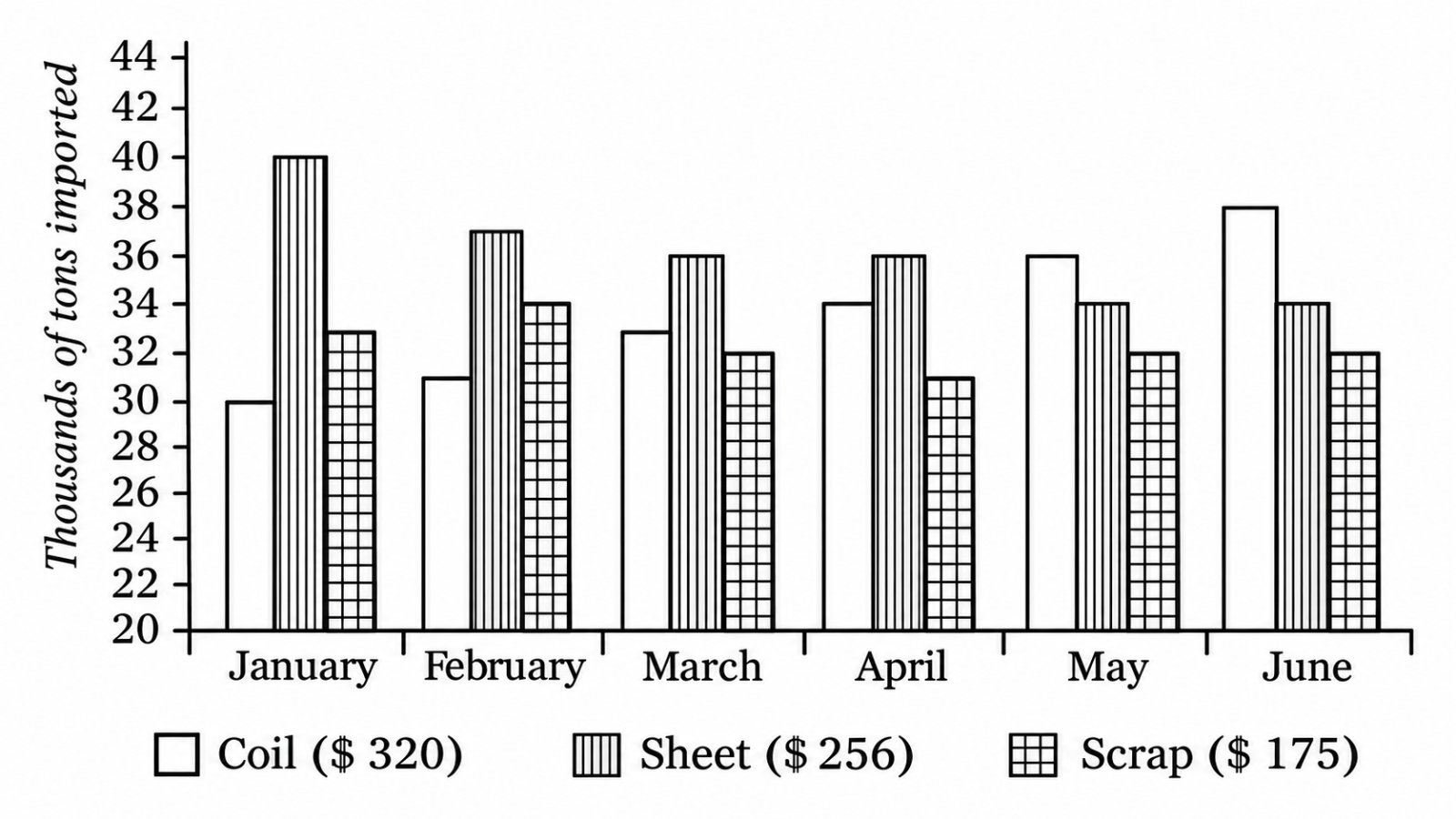
- Q11. Bar Charts Measured ThousandsBy how much (measured in thousands of tons) did the import of sheet steel exceed the import of coil steel in the first three months of the year?
- Q12. Bar Charts Approximate SheetWhat was the approximate total value (in $) of sheet steel imported over the six months period?
- Q13. Bar Charts Approximate RatioWhat was the approximate ratio of sheet steel and scrap steel imports in the first three months of the year?
Directions for Q14–Q16
Directions for the following 3 (three) items:
Rotated positions of a single solid are shown below. The various faces of the solid are marked with different symbols like dots, cross and line. Answer the three items that follow the given figures.
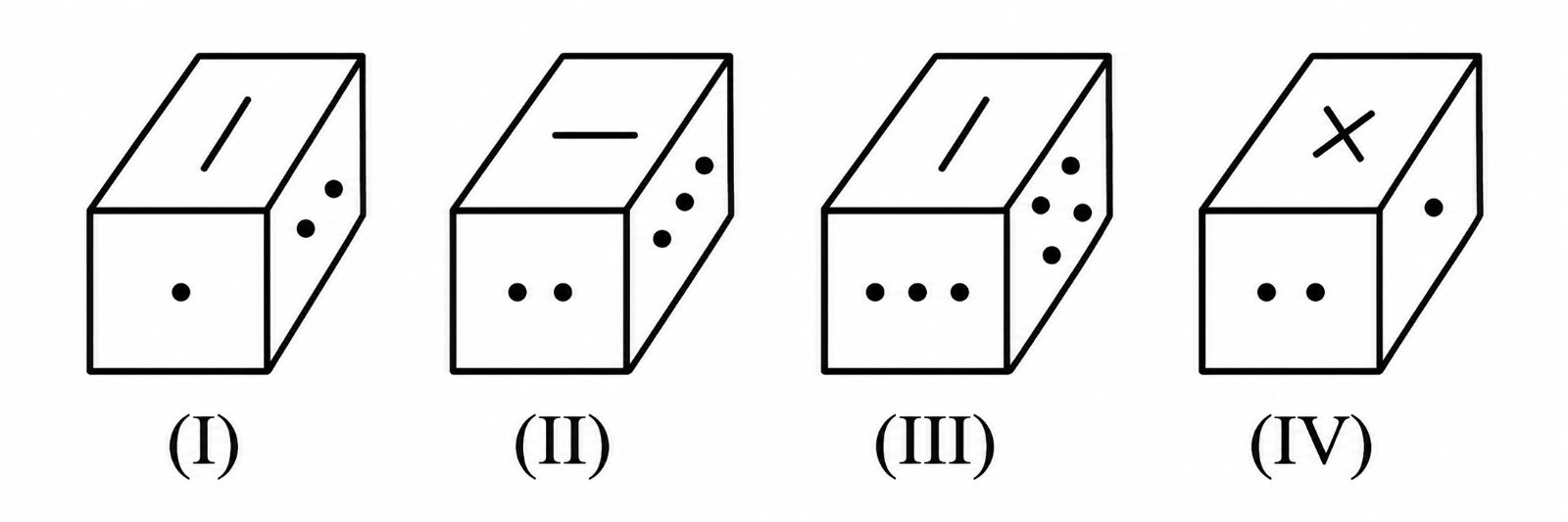
- Q14. Analytical Puzzles Symbol FaceWhat is the symbol on the face opposite to that containing a single dot?
- Q15. Analytical Puzzles Symbol Face OppositeWhat is the symbol on the face opposite to that containing two dots?
- Q16. Analytical Puzzles Symbol Opposite FaceWhat is the symbol on the face opposite to that containing the cross?
Directions for Q17–Q20
Directions: Read the following passage and answer the item that follows. Your answer to this item should be based on the passage only.
Passage
It is no longer enough for us to talk about providing for universal access to education. Making available schooling facilities is an essential prerequisite, but it is insufficient to ensure that all children attend school and participate in the learning process. The school may be there, but children may not attend or they may drop out after a few months. Through school and social mapping, we must address the entire gamut of social, economic, cultural and indeed linguistic and pedagogic issues, factors that prevent children from weaker sections and disadvantaged groups, as also girls, from regularly attending and complementing elementary education. The focus must be on the poorest and most vulnerable since these groups are the most disempowered and at the greatest risk of violation or denial of their right to education.
The right to education goes beyond free and compulsory education to include quality education for all. Quality is an integral part of the right to education. If the education process lacks quality, children are being denied their right. The Right of Children to Free and Compulsory Education Act lays down that the curriculum should provide for learning through activities, exploration and discovery. This places an obligation on us to change our perception of children as passive receivers of knowledge, and to move beyond the convention of using textbooks as the basis of examinations. The teaching-learning process must become stress-free; and a massive programme for curricular reform should be initiated to provide for a child-friendly learning system, that is more relevant and empowering. Teacher accountability systems and processes must ensure that children are learning, and that their right to learn in a child-friendly environment is not violated. Testing and assessment systems must be reexamined and redesigned to ensure that these do not force children to struggle between school and tuition centres, and bypass childhood.
- Q17. Critical Reasoning Education ParamountAccording to the passage, which of the following is/are of paramount importance under the Right to Education?
- Q18. Assumptions Education Guarantees TeachersWith reference to the above passage, the following assumptions have been made :
- Q19. Inference Critical Bringing QualityAccording to the passage, which one of the following is critical in bringing quality in education?
- Q20. Main Idea Essential MessageWhat is the essential message in this passage?
- Q21. Coding Decoding LSJXVC MUMBAIIf LSJXVC is the code for MUMBAI, the code for DELHI is
- Q22. Coding Decoding RAMON DINESHIf RAMON is written as 12345 and DINESH as 675849, then HAMAM will be written as
- Q23. Algebra Solution Since SquaringIf X is between −3 and −1, and Y is between −1 and 1, then X² − Y² is in between which of the following?
- Q24. Algebra Natural Represents LargestX and Y are natural numbers other than 1, and Y is greater than X. Which of the following represents the largest number?
Directions for Q25 and Q26
Directions for the following 2 (two) items :
Read the following information and answer the two items that follow.
The plan of an office block for six officers A, B, C, D, E and F is as follows : Both B and C occupy offices to the right of the corridor (as one enters the office block) and A occupies on the left of the corridor. E and F occupy offices on opposite sides of the corridor but their offices do not face each other. The offices of C and D face each other. E does not have a corner office. F's office is further down the corridor than A's, but on the same side.
Directions for Q27–Q29
Directions: Read the following passage and answer the item that follows. Your answer to this item should be based on the passage only.
Passage
‘Desertification’ is a term used to explain a process of decline in the biological productivity of an ecosystem, leading to total loss of productivity. While this phenomenon is often linked to the arid, semi-arid and sub-humid ecosystems, even in the humid tropics, the impact could be most dramatic. Impoverishment of human-impacted terrestrial ecosystems may exhibit itself in a variety of ways : accelerated erosion as in the mountain regions of the country, salinization of land as in the semi-arid and arid ‘green revolution’ areas of the country, e.g., Haryana and western Uttar Pradesh, and site quality decline—a common phenomenon due to general decline in tree cover and monotonous monoculture of rice/wheat across the Indian plains. A major consequence of deforestation is that it relates to adverse alterations in the hydrology and related soil and nutrient losses. The consequences of deforestation invariably arise out of site degradation through erosive losses. Tropical Asia, Africa and South America have the highest levels of erosion. The already high rates for the tropics are increasing at an alarming rate (e.g., through the major river systems—Ganga and Brahmaputra, in the Indian context), due to deforestation and ill-suited land management practices subsequent to forest clearing. In the mountain context, the declining moisture retention of the mountain soils, drying up of the underground springs and smaller rivers in the Himalayan region could be attributed to drastic changes in the forest cover. An indirect consequence is drastic alteration in the upland-lowland interaction, mediated through water. The current concern the tea planter of Assam has is about the damage to tea plantations due to frequent inundation along the flood-plains of Brahmaputra, and the damage to tea plantation and the consequent loss in tea productivity is due to rising level of the river bottom because of siltation and the changing course of the river system. The ultimate consequences of site desertification are soil degradation, alteration in available water and its quality, and the consequent decline in food, fodder and fuel-wood yields essential for the economic well-being of rural communities.
- Q27. Conclusions Consequences Decline ForestAccording to the passage, which of the following are the consequences of decline in forest cover?
- Q28. Inference Tropical Asia AfricaWhich of the following is/are the correct inference/inferences that can be made from the passage?
- Q29. Assumptions Desertification Phenomenon TropicalWith reference to ‘desertification’ as described in the passage, the following assumptions have been made :
Directions for Q30 and Q31
Directions: Read the following passage and answer the item that follows. Your answer to this item should be based on the passage only.
Passage
A diversity of natural assets will be needed to cope with climate change and ensure productive agriculture, forestry, and fisheries. For example, crop varieties are needed that perform well under drought, heat, and enhanced CO₂. But the private-sector and farmer-led process of choosing crops favours homogeneity adapted to past or current conditions, not varieties capable of producing consistently high yields in warmer, wetter, or drier conditions. Accelerated breeding programmes are needed to conserve a wider pool of genetic resources of existing crops, breeds, and their wild relatives. Relatively intact ecosystems, such as forested catchments, mangroves, wetlands, can buffer the impacts of climate change. Under a changing climate, these ecosystems are themselves at risk, and management approaches will need to be more proactive and adaptive. Connections between natural areas, such as migration corridors, may be needed to facilitate species movements to keep up with the change in climate.
Directions for Q32
Directions: Read the following passage and answer the item that follows. Your answer to this item should be based on the passage only.
Passage
Today, the top environmental challenge is a combination of people and their aspirations. If the aspirations are more like the frugal ones we had after the Second World War, a lot more is possible than if we view the planet as a giant shopping mall. We need to get beyond the fascination with glitter and understand that the planet works as a biological system.
Directions for Q33
Directions: Read the following passage and answer the item that follows. Your answer to this item should be based on the passage only.
Passage
Some people believe that leadership is a quality which you have at birth or not at all. This theory is false, for the art of leadership can be acquired and can indeed be taught. This discovery is made in time of war and the results achieved can surprise even the instructors. Faced with the alternatives of going left or right, every soldier soon grasps that a prompt decision either way is better than an endless discussion. A firm choice of direction has an even chance of being right while to do nothing will be almost certainly wrong.
- Q34. Number System Consists DigitsA number consists of three digits of which the middle one is zero and their sum is 4. If the number formed by interchanging the first and last digits is greater than…
- Q35. Geometry Mensuration Solid CubeA solid cube of 3 cm side, painted on all its faces, is cut up into small cubes of 1 cm side. How many of the small cubes will have exactly two painted faces?
- Q36. Permutations Combinations 1000 WhileWhile writing all the numbers from 700 to 1000, how many numbers occur in which the digit at hundred’s place is greater than the digit at ten’s place, and the digit at…
- Q37. Ordering Ranking Pen PencilIf Pen < Pencil, Pencil < Book and Book > Cap, then which one of the following is always true?
- Q38. Algebra Geography History MathematicsA bookseller sold ‘a’ number of Geography textbooks at the rate of ₹ x per book, ‘a+2’ number of History textbooks at the rate of ₹(x+2) per book and ‘a−2’ number of…
- Q39. Probability Bag Contains RedA bag contains 15 red balls and 20 black balls. Each ball is numbered either 1 or 2 or 3. 20% of the red balls are numbered 1 and 40% of them are numbered 3. Similarly,…
- Q40. Time Speed Distance Running CircularTwo persons, A and B are running on a circular track. At the start, B is ahead of A and their positions make an angle of 30° at the centre of this circle. When A…
- Q41. Percentages Student Marks ExaminationA student has to get 40% marks to pass in an examination. Suppose he gets 30 marks and fails by 30 marks, then what are the maximum marks in the examination?
- Q42. Venn Diagrams Turn Out19 boys turn out for playing hockey. Of these, 11 are wearing hockey shirts and 14 are wearing hockey pants. There are no boys without shirts and/or pants. What is the…
Directions for Q43–Q48
Directions for the following 6 (six) items :
Read the information given below and answer the six items that follow.
A, B, C and D are students. They are studying in four different cities, viz., P, Q, R and S (not necessarily in that order). They are studying in Science college, Arts college, Commerce college and Engineering college (not necessarily in that order), which are situated in four different States, viz., Gujarat, Rajasthan, Assam and Kerala (not necessarily in that order). Further, it is given that—
(i) D is studying in Assam (ii) Arts college is located in city S which is in Rajasthan (iii) A is studying in Commerce college (iv) B is studying in city Q (v) Science college is located in Kerala
- Q43. Analytical Puzzles Gujarat StudyingA is studying in
- Q44. Analytical Puzzles Science CollegeScience college is located in
- Q45. Analytical Puzzles Rajasthan StudyingC is studying in
- Q46. Analytical Puzzles Studying CityWhich one of the following statements is correct?
- Q47. Analytical Puzzles Engineering CollegeWhich one of the following statements is correct regarding Engineering college?
- Q48. Analytical Puzzles Engineering College LocatedWhich one of the following statements is correct?
Directions for Q49
Directions: Read the following passage and answer the item that follows. Your answer to this item should be based on the passage only.
Passage
All actions to address climate change ultimately involve costs. Funding is vital in order for countries like India to design and implement adaptation and mitigation plans and projects. The problem is more severe for developing countries like India, which would be one of the hardest hit by climate change, given its need to finance development. Most countries do indeed treat climate change as real threat and are striving to address it in a more comprehensive and integrated manner with the limited resources at their disposal.
Directions for Q50
Directions: Read the following passage and answer the item that follows. Your answer to this item should be based on the passage only.
Passage
Cooking with biomass and coal in India is now recognized to cause major health problems, with women and children in poor populations facing the greatest risk. There are more than 10 lakh premature deaths each year from household air pollution due to polluting cooking fuels with another 1·5 lakh due to their contribution to general outdoor air pollution in the country. Although the fraction of the Indian population using clean cooking fuels, such as LPG, natural gas and electricity, is slowly rising, the number using polluting solid fuels as their primary cooking fuel has remained static for nearly 30 years at about 70 crore.
Directions for Q51
Directions: Read the following passage and answer the item that follows. Your answer to this item should be based on the passage only.
Passage
Scientific knowledge has its dangers, but so has every great thing. Over and beyond the dangers with which it threatens the present, it opens up as nothing else can, the vision of a possible happy world; a world without poverty, without war, with little illness. Science, whatever unpleasant consequences it may have by the way, is in its very nature a liberator.
Directions for Q52
Directions: Read the following passage and answer the item that follows. Your answer to this item should be based on the passage only.
Passage
The Arctic’s vast reserves of fossil fuel, fish and minerals are now accessible for a longer period in a year. But unlike Antarctica, which is protected from exploitation by the Antarctic Treaty framed during the Cold War and is not subject to territorial claims by any country, there is no legal regime protecting the Arctic from industrialization, especially at a time when the world craves for more and more resources. The distinct possibility of ice-free summer has prompted countries with Arctic coastline to scramble for great chunks of the melting ocean.
Directions for Q53
Directions: Read the following passage and answer the item that follows. Your answer to this item should be based on the passage only.
Passage
Being a member of the WTO, India is bound by the agreements that have been signed and ratified by its members, including itself. According to Article 6 of the Agriculture Agreement, providing minimum support prices for agricultural products is considered distorting and is subject to limits. The subsidy arising from ‘minimal supports’ cannot exceed 10 per cent of the value of agricultural production for developing countries. PDS in India entails minimum support prices and public stockholding of food grains. It is possible that, in some years, the subsidy to producers will exceed 10 per cent of the value of agricultural production.
Directions for Q54
Directions: Read the following passage and answer the item that follows. Your answer to this item should be based on the passage only.
Passage
India’s educational system is modelled on the mass education system that developed in the 19th century in Europe and later spread around the world. The goal of the system is to condition children as ‘good’ citizens and productive workers. This suited the industrial age that needed the constant supply of a compliant workforce with a narrow set of capabilities. Our educational institutes resemble factories with bells, uniforms and batch-processing of learners, designed to get learners to conform. But, from an economic point of view, the environment today is very different. It is a complex, volatile and globally interconnected world.
Directions for Q55
Directions: Read the following passage and answer the item that follows. Your answer to this item should be based on the passage only.
Passage
The practice of dieting has become an epidemic; everyone is looking out for a way to attain that perfect body. We are all different with respect to our ethnicity, genetics, family history, gender, age, physical and mental and spiritual health status, lifestyles and preferences. Thereby we also differ in what foods we tolerate or are sensitive to. So we really cannot reduce so many complexities into one diet or diet book. This explains the failure of diets across the world in curbing obesity. Unless the reasons for weight gain are well understood and addressed and unless habits are changed permanently, no diet is likely to succeed.
Directions for Q56
Directions: Read the following passage and answer the item that follows. Your answer to this item should be based on the passage only.
Passage
Monoculture carries great risks. A single disease or pest can wipe out swathes of the world’s food production, an alarming prospect given that its growing and wealthier population will eat 70% more by 2050. The risks are magnified by the changing climate. As the planet warms and monsoon rains intensify, farmlands in Asia will flood. North America will suffer more intense droughts, and crop diseases will spread to new latitudes.
- Q57. Profit Loss Shopkeeper ArticleA shopkeeper sells an article at ₹ 40 and gets X% profit. However, when he sells it at ₹ 20, he faces same percentage of loss. What is the original cost of the article?
- Q58. Geometry Mensuration Equally SpacedThere are 24 equally spaced points lying on the circumference of a circle. What is the maximum number of equilateral triangles that can be drawn by taking sets of three…
- Q59. Calendar Problems Sequence NextConsider the sequence given below :
- Q60. Geometry Mensuration Twelve SquaresTwelve equal squares are placed to fit in a rectangle of diagonal 5 cm. There are three rows containing four squares each. No gaps are left between adjacent squares.…
CSAT is a qualifying paper.