UPSC CSE 2022 CSAT · Question 30
UPSC CSE 2022 CSAT question on Ordering Ranking Standing Queue
CSAT is a qualifying paper.
- ExamUPSC CSE - CSAT
- Year2022
- PaperCSAT (General Studies Paper II)
- SubjectLogical reasoning and analytical ability
- TopicOrdering and ranking
- DifficultyHard
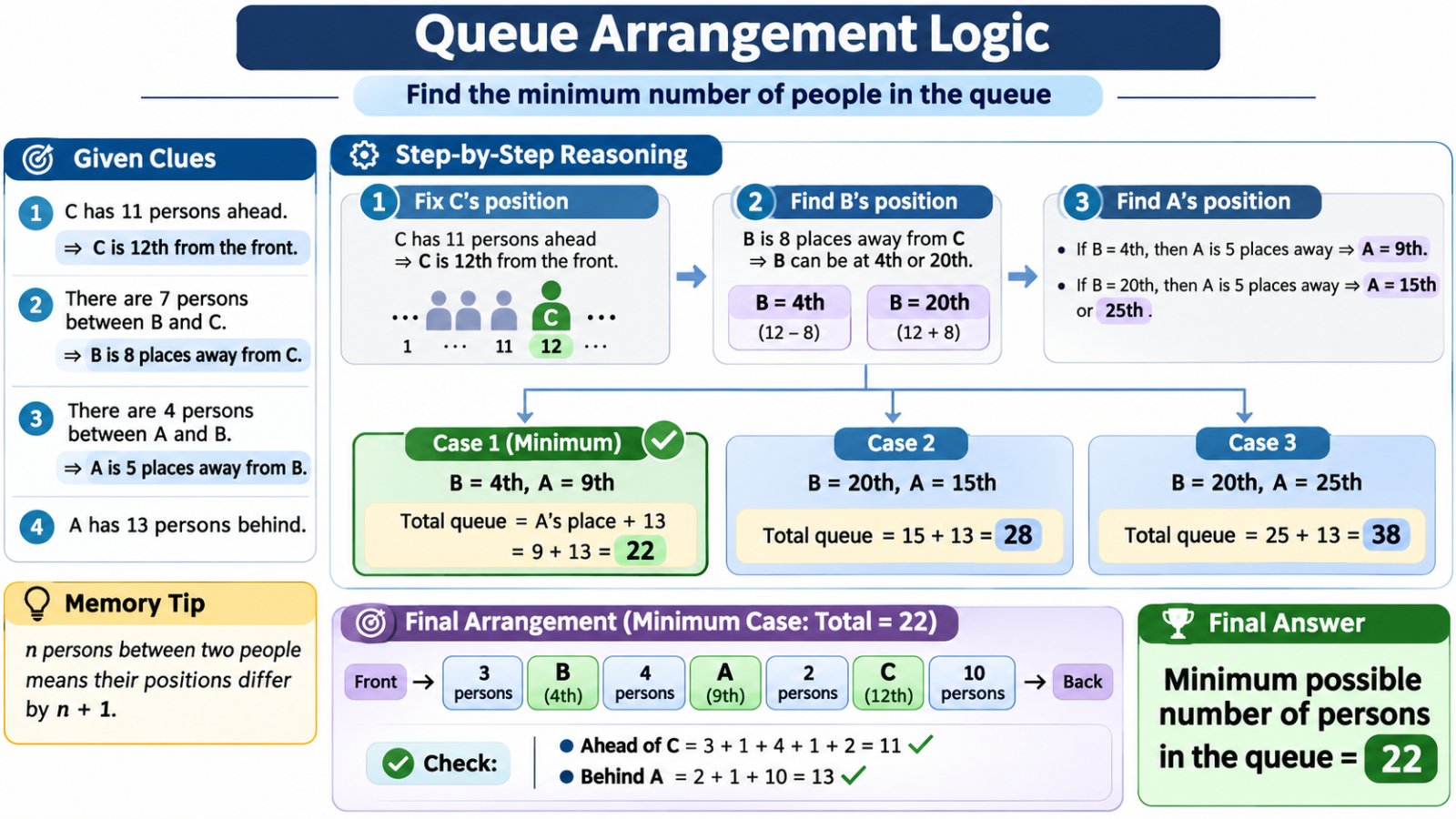
Three persons A, B and C are standing in a queue not necessarily in the same order. There are 4 persons between A and B, and 7 persons between B and C. If there are 11 persons ahead of C and 13 behind A, what could be the minimum number of persons in the queue?
Show answer
Answer: A. 22
Solution
- C has 11 persons ahead, so C is 12th from the front.
- B is 8 places from C (7 persons between): B is 4th or 20th.
- A is 5 places from B (4 persons between).
- If B is 4th: A is 9th (A cannot be at −1).
- If B is 20th: A is 15th or 25th.
- A has 13 persons behind, so total = A's place + 13.
- A 9th → 22 persons; A 15th → 28; A 25th → 38.
- Minimum = 22. Order from the front: 3 persons, B (4th), 4 persons, A (9th), 2 persons, C (12th), 10 persons.
- Check: ahead of C = 3 + 1 + 4 + 1 + 2 = 11 ✓; behind A = 2 + 1 + 10 = 13 ✓.
Why the other options are wrong
- (b) 28: a valid queue (A 15th), but not the smallest.
- (c) 32: does not match any arrangement.
- (d) 38: a valid queue (A 25th), the largest case.
Quick trick
- Fix C at 12th, then place A as far forward as possible; total = A's place + 13.
Remember
"n persons between" means the positions differ by n + 1.
Hence the answer is (a).
Share
Ask Atlas (3) for similar questions
- Ordering Ranking Left End — Same position-from-ends and between-persons counting in a row, linking two reference people.
- Ordering Ranking Ramesh Students — Same ranking-from-top versus from-bottom conversion using total count, like converting positions in a queue.
- Ordering Ranking Incomprehensibilities Letters — Also a positional counting puzzle requiring careful offset arithmetic over a fixed sequence.
← Full UPSC CSE 2022 CSAT paper · All Logical reasoning and analytical ability questions